 Om Prakash Rana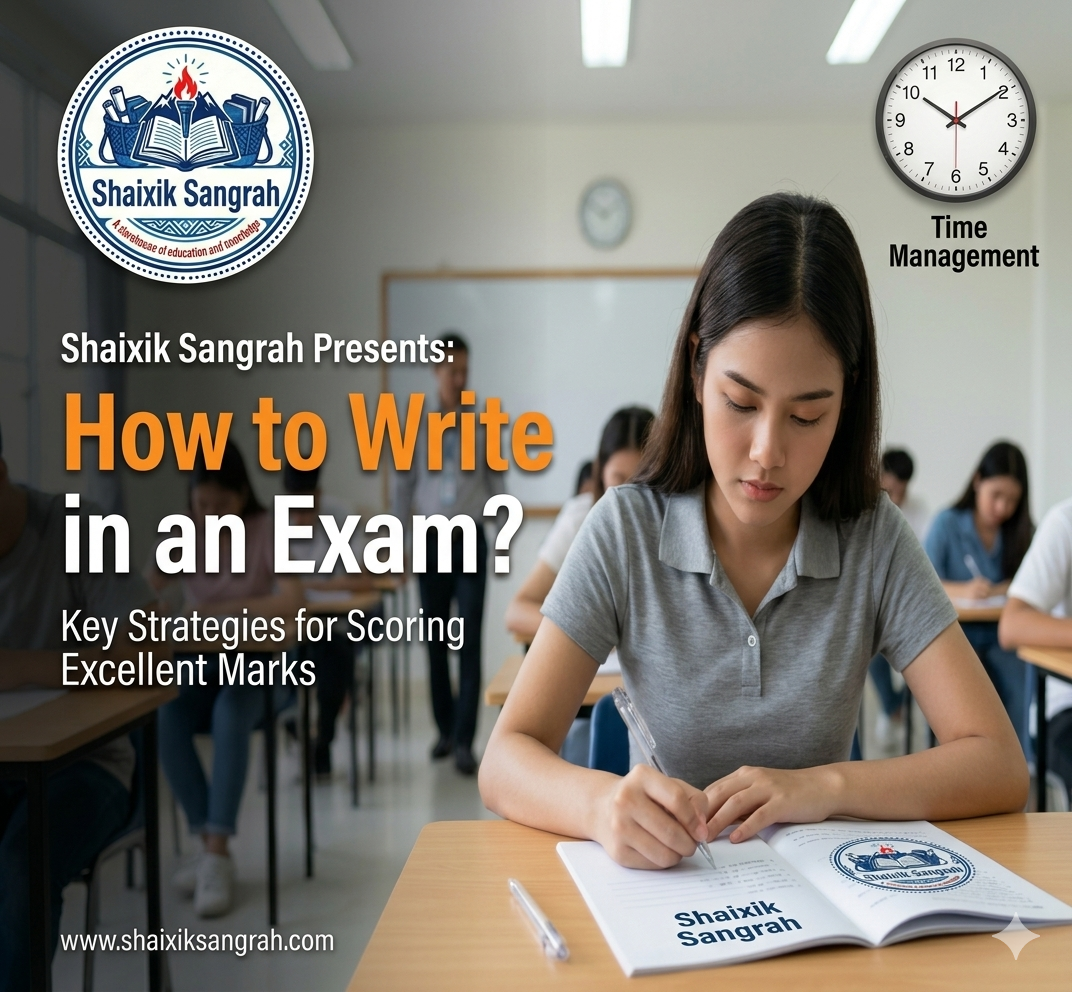
How to write in exams? Surefire ways to score excellent marks?
Exams are an important way to measure students’ learning and ability. Reading a lot alone does not guarantee a good score in exams; how you present what you know in the answer sheet plays the biggest role.Due to the lack of the Art of Answering in exams, many students are not able to score well even on questions they know.
Therefore, here are some important tips on how to write in exams and how to score excellent marks:
1. What to do as soon as you get the question paper?
* Reading carefully: Spend the first 10 to 15 minutes reading the question paper carefully. It is very important to clearly understand what each question is asking.* Planning: Think about which questions you think best, prepare a mental outline of them, and start writing with easy questions. This increases confidence.
* Time allocation: Decide in advance how much time you will give to each question based on the total time and total marks.
2. Things to consider while writing answers
* Length according to the weighting: The length of the answer should be determined according to the number of marks the question carries. Writing 1 page for a 2-mark question and half a page for a 10-mark question are both mistakes.
* Writing to the Point: Get straight to the point with what the question asks. Filling up the answer sheet with unnecessary things will not get you many marks. The examiner is always looking for solid and relevant answers.
* Bullet Points: Try to write the answers in bullet points instead of paragraphs as much as possible. This makes it easier for the examiner to read and makes a good impression.
* Use of Figures and Tables: In subjects like science, geography, economics, you can get very good marks by making diagrams, graphs or tables where necessary.
3. Structure of the AnswerEspecially when writing long answers, they should be divided into three parts:
* Introduction: Brief information or definition of the main topic of the question.
* Body: A detailed explanation, cause, effect or analysis of what is being asked. It is best to write it in bullet points.
* Conclusion: Conclude the answer by summarizing the overall answer or your logical opinion.
4. Presentation and Cleanliness
* Clear writing: The writing does not have to be like pearls, but it should be easy for the examiner to understand, clean and clear.
* Underlining: Underline important dates, names, principles or key points that come up while writing the answer with a pencil. This draws the examiner’s attention directly to the main point.
* Do not cross out: If a word is misspelled or made a mistake, cross it out with a single line. Too much cross-checking makes the answer sheet look messy.
* Spacing: After answering one question, leave at least two lines blank before starting the next one.
5. Use the last time wisely (Revision)
- Aim to finish writing all the answers 10-15 minutes before the end of the exam.
- Check your roll number, symbol number and other details in the remaining time whether they are correct or not.
- Check the question paper to see if all the answers have been written or not. Sometimes, even a question can be missed due to rushing.In conclusion,
The exam is not only a test of your knowledge but also a test of your presentation and time management. If you practice writing keeping in mind the above-mentioned things, you can definitely achieve excellent results in the exam.